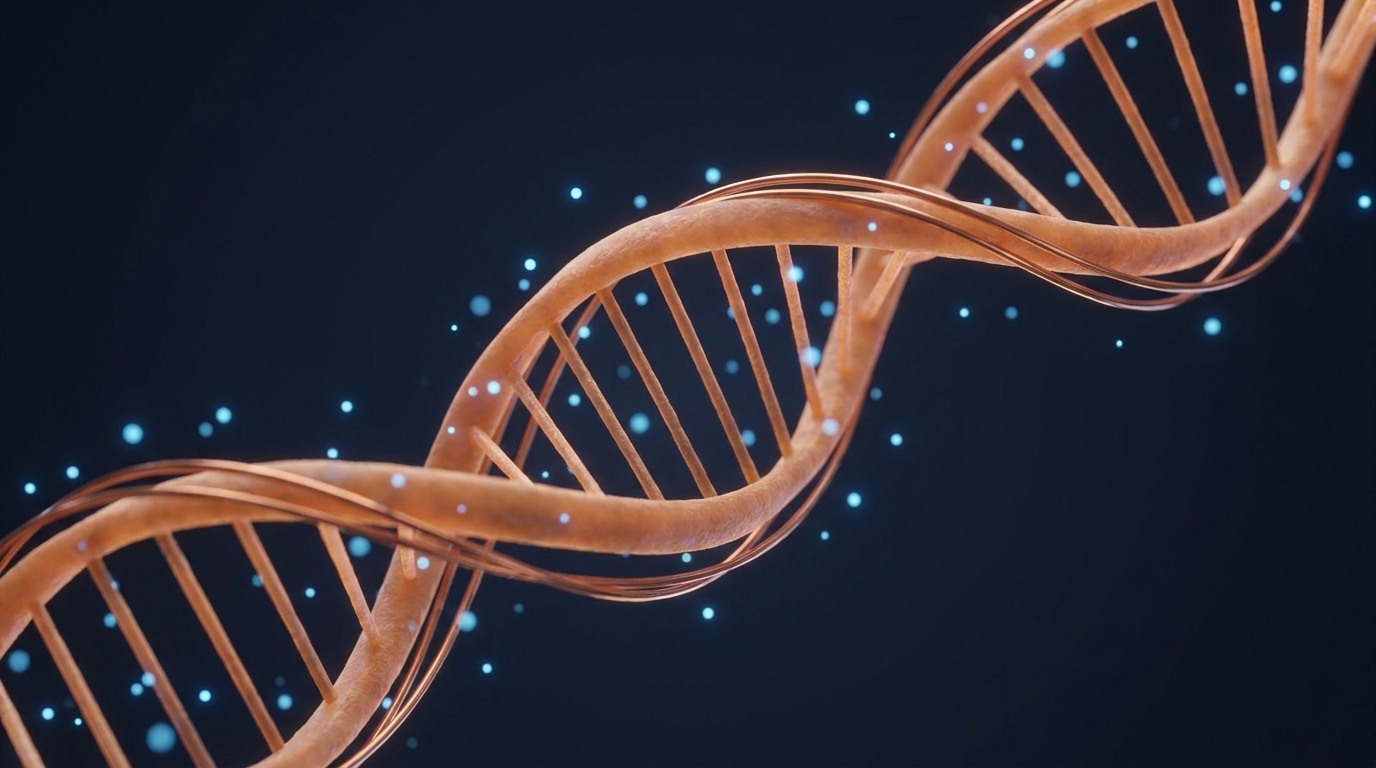
The Aging Genome & GHK-Cu's Transcriptional Reset
Human plasma GHK-Cu concentration follows a striking age-dependent decline: approximately 200 ng/mL in the third decade, dropping to ~80 ng/mL by the sixth decade, and approaching analytical detection limits in the eighth decade and beyond. This trajectory correlates with the progressive deterioration of skin architecture, tissue repair capacity, and systemic regenerative potential that characterises biological aging.
A pivotal genome-wide study by Pickart, Vasquez-Soltero, and Margolina (2012) used Broad Institute gene expression data to map GHK-Cu's regulatory influence across the human transcriptome. The results were unprecedented in scope: GHK-Cu modulated the expression of 4,153 human genes — approximately 14% of the entire genome — with consistent directional bias toward youth-associated expression patterns.
The mechanistic basis for this broad transcriptional effect involves multiple parallel pathways. GHK-Cu's copper(II) coordination chemistry enables direct interaction with DNA-binding domains of several transcription factors. Additionally, the histidine residue of the tripeptide participates in copper-mediated superoxide dismutation reactions that alter intracellular redox state — a known modulator of redox-sensitive transcription factors including Nrf2, AP-1, and SP-1.
The Broad Institute dataset analysis identified a strong anti-cancer signature in GHK-Cu's gene modulation profile: the peptide consistently reversed the transcriptional changes associated with metastatic colorectal, lung, and breast cancer lines toward non-transformed expression patterns. While human therapeutic implications require clinical trial evidence, the in vitro genomic data represents one of the most comprehensive transcriptome resets documented for any endogenous peptide.
Ubiquitin & Proteasome Pathway Specificity
A focused bioinformatic analysis of the GHK-Cu gene set revealed particular enrichment in ubiquitin ligase pathway components — genes responsible for tagging damaged proteins for proteasomal degradation. Age-related decline in proteasome activity is a well-documented driver of intracellular protein aggregate accumulation. GHK-Cu's restoration of these pathways may partly explain its documented ability to improve skin structural integrity through removal of glycated and oxidised collagen fragments, creating space for newly synthesised functional matrix.
Collagen Synthesis & ECM Remodelling Cascades
Extracellular matrix homeostasis requires balanced synthesis and degradation. Aging disrupts this balance through reduced fibroblast synthetic activity, increased matrix metalloproteinase (MMP) expression, and cross-linking of existing collagen by advanced glycation end products (AGEs). GHK-Cu operates simultaneously on multiple nodes of this network.
| ECM Component | GHK-Cu Effect | Study Type | Magnitude |
|---|---|---|---|
| Type I Collagen | Synthesis ↑ via TGF-β1 and COL1A1/COL1A2 transcription | In vitro | Up to 8× increase in fibroblast cultures |
| Type III Collagen | Synthesis ↑; ratio toward elasticity-associated profile | In vitro | Significant vs. untreated controls |
| Elastin | Synthesis ↑ alongside collagen; improved skin elasticity outcomes | Clinical | Improved elasticity scores in RCTs |
| Fibronectin | Upregulation supports keratinocyte and fibroblast adhesion | In vitro | Consistent across multiple cell lines |
| Glycosaminoglycans | Synthesis ↑ (dermatan sulfate, heparan sulfate); improved hydration | In vitro | Quantified by ELISA in culture media |
| MMP-1 / MMP-2 | Context-dependent: increases degradation of old/damaged matrix, not new synthesis | In vitro | Net matrix quality improvement |
TGF-β and the Fibroblast Activation Loop
GHK-Cu's most well-characterised collagen-inductive mechanism proceeds through transforming growth factor-beta 1 (TGF-β1) activation. In quiescent dermal fibroblasts, GHK-Cu binding to cell surface receptors triggers TGF-β1 autocrine/paracrine secretion, which in turn activates SMAD2/3 transcription factors driving COL1A1 and COL1A2 promoter activity. Critically, this pathway does not require external TGF-β supplementation — GHK-Cu initiates the signalling cascade endogenously.
A parallel pathway operates through fibroblast growth factor receptor (FGFR) activation. GHK-Cu has been shown to upregulate FGF-2 and FGF-7 expression, both of which stimulate fibroblast proliferation and collagen synthetic activity. This dual-pathway activation (TGF-β + FGF axis) provides a redundant and robust stimulus for matrix renewal.
Early concern that GHK-Cu's MMP upregulation might degrade newly synthesised collagen has been resolved by longitudinal ECM studies. GHK-Cu-activated MMPs preferentially target glycated, cross-linked, and denatured collagen fragments rather than triple-helical native collagen. Net matrix effect is strongly positive: damaged matrix clearance followed by new high-quality collagen deposition — analogous to controlled demolition followed by reconstruction.
Copper's Direct Enzymatic Role
Beyond gene regulation, the copper ion in GHK-Cu serves as a direct enzymatic cofactor. Lysyl oxidase — the enzyme responsible for collagen and elastin cross-linking — is a copper-dependent amine oxidase. Insufficient tissue copper is a known cause of structurally weak, lax connective tissue. GHK-Cu's copper delivery to the pericellular environment ensures that newly synthesised collagen fibres undergo proper enzymatic cross-linking, resulting in mechanically competent rather than simply abundant matrix.
Hair Follicle Biology & Activation Mechanisms
Hair follicle cycling — the progression through anagen (growth), catagen (regression), and telogen (rest) phases — is governed by a complex interplay of growth factors, dermal papilla cell signalling, and androgen-mediated transcriptional regulation. Age-related miniaturisation of follicles, particularly in androgenetic alopecia, represents a progressive failure of anagen initiation and maintenance. GHK-Cu engages multiple nodes in this regulatory network.
Clinical & Preclinical Evidence for Hair Effects
| Study Model | Intervention | Key Finding | Level |
|---|---|---|---|
| C57BL/6 mouse (shaved dorsal) | Topical GHK-Cu 0.1% vs. minoxidil 2% | GHK-Cu induced comparable anagen acceleration to minoxidil; follicle density equivalent at day 21 | Animal |
| Human dermal papilla cell culture | GHK-Cu 1–100 nM | Dose-dependent increase in VEGF, IGF-1, and KGF secretion; 3× increase at 10 nM vs. untreated | In vitro |
| Ex vivo human scalp organ culture | GHK-Cu 10 nM, 14 days | Prolonged anagen phase; reduced catagen entry compared to vehicle control | Ex vivo |
| Androgenetic alopecia — clinical pilot | Topical GHK-Cu preparation, 6 months | Improvement in hair density and shaft diameter scores; reduced shedding by self-report | Clinical |
| 5α-reductase activity assay | GHK-Cu vs. finasteride (positive control) | GHK-Cu reduced type II 5α-reductase activity by ~35% at 100 μM; additive effect with finasteride | In vitro |
Anagen Phase Prolongation: The Core Mechanism
The transition from anagen to catagen is triggered by the intrinsic apoptotic programme in follicle keratinocytes, mediated by BCL-2 family protein imbalance (decreased BCL-2, increased BAX). GHK-Cu's genomic upregulation of BCL-2 and BCL-XL in follicle keratinocytes directly suppresses this apoptotic signal, functionally extending the anagen growth window per cycle. In a follicle already under DHT-mediated stress with shortened anagen phases, this BCL-2 upregulation represents a mechanistically direct intervention against miniaturisation.
Androgenetic alopecia results from a progressive reduction in anagen phase duration across successive follicle cycles — from ~5 years in healthy scalp to months or weeks in miniaturised follicles. GHK-Cu's combination of DHT suppression (reducing the androgen signal that initiates miniaturisation), VEGF-driven perifollicular angiogenesis (restoring nutrient supply to starved miniaturised follicles), and BCL-2 upregulation (extending each anagen phase) addresses the three core elements of the miniaturisation process simultaneously. This multi-target profile distinguishes it from single-mechanism agents such as finasteride (5AR inhibition only) or minoxidil (vasodilation only).
Interaction with the Wnt Pathway
Wnt/β-catenin signalling in dermal papilla cells is obligatory for anagen induction — conditional knockout of β-catenin in dermal papilla permanently arrests follicles in telogen. GHK-Cu's activation of FGF-7 (KGF) promotes Wnt ligand expression in dermal papilla cells through a cross-regulatory loop, and the copper-dependent antioxidant activity reduces intracellular ROS that would otherwise promote β-catenin proteasomal degradation via GSK-3β. The net effect is stabilisation and nuclear accumulation of β-catenin, enhancing Lef/TCF-mediated transcription of anagen-promoting target genes.
Dosing Precision for Research Models
GHK-Cu's genomic activity is dose-sensitive: genomic studies have identified a hormetic dose-response curve in which optimal gene expression modulation occurs within a specific concentration window, with diminishing or reversed effects at very high concentrations. Research model selection determines the appropriate concentration range.
GHK-Cu is stable in aqueous solution at physiological pH (7.0–7.4) at 4°C for up to 3 months, and at −20°C for 12+ months. Avoid freeze-thaw cycling >3 times. pH below 6.0 promotes copper dissociation; maintain neutral pH in all experimental buffers. Light exposure degrades the copper complex — store in amber vessels.